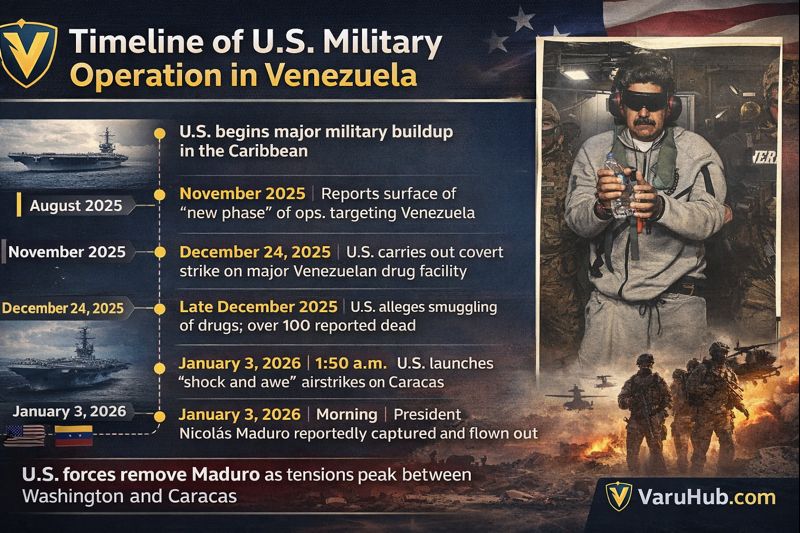
WASHINGTON — The Trump administration confirmed Monday that U.S. forces captured former Venezuelan leader Nicolás Maduro in a tightly coordinated operation in Caracas, a move officials say reflects a major shift in American foreign policy toward the Western Hemisphere and narcotrafficking networks operating near U.S. borders.
Maduro, 66, and his wife, Cilia Flores, appeared for the first time in federal court in New York after being charged with narco-terrorism conspiracy, cocaine importation, weapons offenses, and money laundering in the Southern District of New York. Both pleaded not guilty.
The operation, dubbed Operation Absolute Resolve, was authorized by President Donald Trump and carried out by U.S. special operations forces. Administration officials emphasized that the mission was limited in duration, did not involve an invasion, and resulted in no American casualties.
Rubio: “We’re Not at War With Venezuela”
Secretary of State Marco Rubio appeared across multiple Sunday news programs, framing the operation as a law-enforcement and national security action rather than a military conflict.
“We are at war against drug trafficking organizations, not against Venezuela,” Rubio said, adding that U.S. forces were on the ground in Caracas for roughly two hours during the capture.
Rubio rejected claims that the operation required congressional authorization, stating it did not constitute an extended military campaign. He said Congress would be notified in accordance with existing law.
“This is the Western Hemisphere,” Rubio said. “This is where we reside. We’re not going to allow it to become a base of operations for drug traffickers, Iranian proxies, or hostile regimes.”
Charges Stem From Long-Running U.S. Investigation
U.S. prosecutors allege Maduro led a decades-long criminal enterprise that partnered with transnational drug cartels to traffic cocaine into the United States while using state institutions to protect the operation. The indictment also accuses Maduro and Flores of conspiring to possess machine guns and destructive devices.
The Justice Department has pursued the case for years, including a $25 million reward for information leading to Maduro’s capture that was first announced during the Biden administration.
Rubio noted that while previous administrations issued indictments and rewards, the Trump administration chose to act.
“There was a reward for his capture,” Rubio said. “The difference is this president enforced it.”
Administration Calls Maduro an “Illegitimate Leader”
The Trump administration has repeatedly referred to Maduro as an illegitimate former leader, citing disputed elections, including Venezuela’s 2024 presidential vote.
“Maduro was not the head of state,” Rubio said. “He was an indicted drug trafficker who stayed in power through fraud.”
Under Venezuela’s constitution, Executive Vice President Delcy Rodríguez is next in the line of succession, though the administration has not formally recognized her authority.
Focus on Drugs, Oil, and Foreign Influence
Officials said the operation follows months of intensified economic pressure on Venezuela, including enforcement of oil sanctions and seizures of tankers accused of illegally shipping crude abroad.
Rubio said the administration’s immediate goals include halting drug trafficking routes, ending the presence of Iran and Hezbollah in Venezuela, and preventing Venezuelan oil revenues from benefiting U.S. adversaries.
“What matters is what happens next,” Rubio said. “Do the drugs stop? Is Iran expelled? Are these groups no longer able to operate against U.S. interests?”
A Broader Strategic Message
The Maduro arrest comes as the Trump administration refocuses U.S. national security policy on the Americas, arguing that rival powers have expanded influence across Latin America in recent decades.
Rubio criticized past U.S. foreign policy for treating conflicts uniformly, saying the Western Hemisphere requires a different approach.
“This isn’t the Middle East,” he said. “Our mission here is very different.”
Administration officials say all policy options remain on the table should Venezuela fail to meet U.S. conditions following Maduro’s removal.
What Comes Next
Maduro and Flores remain in federal custody in New York as pretrial proceedings begin. The case is expected to provide new details about alleged ties between Venezuelan officials, international drug cartels, and foreign governments.
For now, the Trump administration says its priority is U.S. security, not long-term governance in Venezuela.
“The number one thing we care about,” Rubio said, “is the safety, security, and prosperity of the United States.”
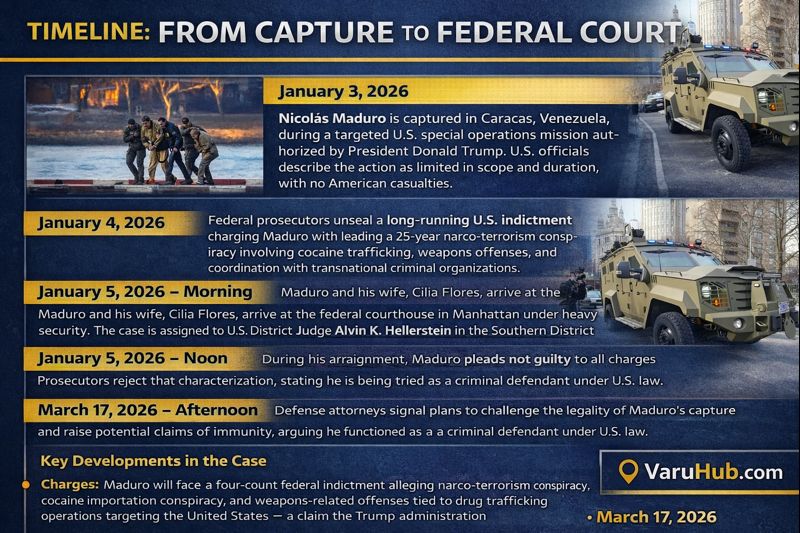
Timeline: From Capture to Federal Court
January 3, 2026
Nicolás Maduro is captured in Caracas, Venezuela, during a targeted U.S. special operations mission authorized by President Donald Trump. U.S. officials describe the action as limited in scope and duration, with no American casualties.
January 4, 2026
Federal prosecutors unseal a long-running U.S. indictment charging Maduro with leading a 25-year narco-terrorism conspiracy involving cocaine trafficking, weapons offenses, and coordination with transnational criminal organizations.
January 5, 2026
Maduro and his wife, Cilia Flores, arrive at the federal courthouse in Manhattan under heavy security. The case is assigned to U.S. District Judge Alvin K. Hellerstein in the Southern District of New York.
January 5, 2026 — Noon
During his arraignment, Maduro pleads not guilty to all charges and declares himself a “prisoner of war.” Prosecutors reject that characterization, stating he is being tried as a criminal defendant under U.S. law.
January 5, 2026 — Afternoon
Defense attorneys signal plans to challenge the legality of Maduro’s capture and raise potential claims of immunity, arguing he functioned as a head of state. Lawyers also reference health concerns. The court agrees to reconvene after initial filings.
March 17, 2026
Judge Hellerstein schedules the next court date to address discovery, pretrial motions, and jurisdictional issues.
Key Developments in the Case
• Charges:
Maduro faces a four-count federal indictment alleging narco-terrorism conspiracy, cocaine importation conspiracy, and weapons-related offenses tied to drug trafficking operations targeting the United States.
• Legal Strategy:
Defense attorneys are expected to challenge the legality of Maduro’s transfer to U.S. custody and argue that he retains immunity as a foreign leader — a claim the Trump administration disputes, calling him an illegitimate former ruler.
• Bail:
Bail was not requested at the initial arraignment, though the issue could be revisited at a later stage in the proceedings.
Illegitimate Leader Maduro Appears in U.S. Court After Capture by American Forces
By Mike Miller • Jan 5, 2026
Discussion
Please log in to join the conversation.
No approved comments yet.